



Traveling across countries often means dealing with different plug standards (US, UK, EU, AU) and limited power outlets in hotels or airports. Charging a phone, laptop, earbuds, and even a drone at the same time can quickly become frustrating.
In 2026, GaN (Gallium Nitride) technology has transformed travel charging. Bulky adapters are being replaced by compact, high-power solutions that combine global plug conversion and fast charging in one device.
This guide introduces a smart "1+N travel charging setup", designed for modern business travelers and digital nomads.
1. Core Device: BWOO BO-UC07 — Your Global Power Passport
Product Title
BWOO GaN Travel Adapter 45W 4 in 1
The BWOO BO-UC07 is designed as an all-in-one travel solution, combining plug conversion and fast charging into a compact device.
Key Features
4-in-1 Plug Design: Supports US, AUS, UK, and EU standards
45W GaN Fast Charging: Efficient and compact power delivery
One-Touch Switching: Easy plug conversion with a single action
4 USB Outputs: Charge multiple devices simultaneously
Wide Voltage Support: Compatible with AC 100–250V worldwide
Why It Stands Out
Replaces multiple chargers and adapters
Reduces travel weight and cable clutter
Provides stable power for phones, tablets, and laptops
2. The Ideal 2026 Travel Charging Combo (1+N Setup)
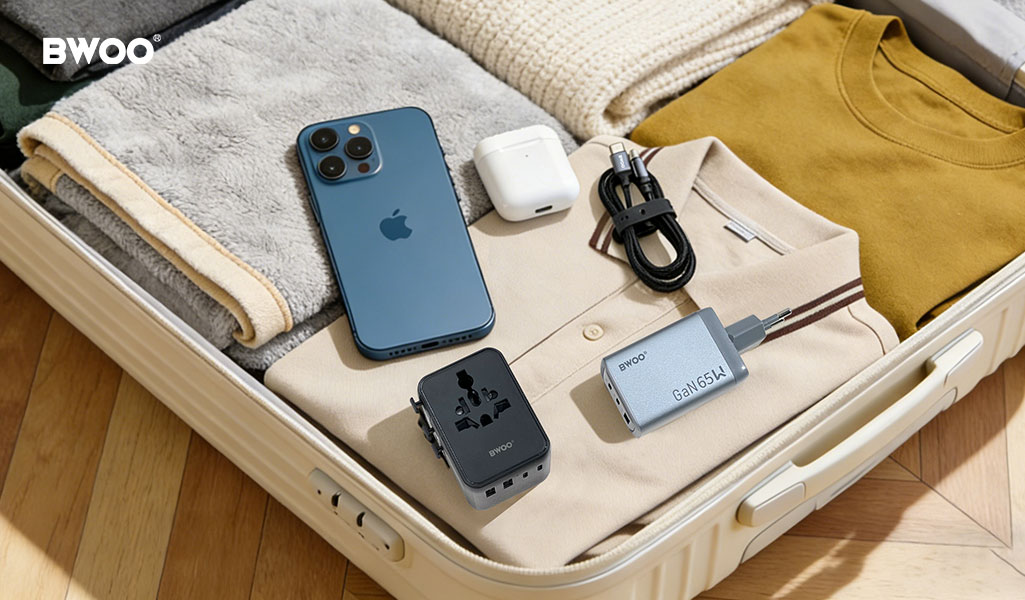
To build a complete travel charging system, the adapter should be paired with essential accessories.
1. High-Power USB-C Cable
Choose a durable cable that supports 100W–240W fast charging.
Why it matters:
Ensures full-speed charging for laptops and tablets
Prevents bottlenecks caused by low-spec cables
2. Compact Magnetic Power Bank (10000mAh)
A slim, portable power bank is essential for:
Flights (where charging may be restricted)
Outdoor activities or transit
Best choice:
Magnetic wireless charging support
Lightweight and airline-compliant capacity
3. Foldable 3-in-1 Wireless Charging Station
Perfect for hotel use, keeping your devices organized.
Benefits:
Charge phone, earbuds, and smartwatch in one place
Reduces cable clutter on bedside tables
3. Why BWOO BO-UC07 Is a 2026 Bestseller for Distributors
Compliance & Safety
For B2B buyers, safety is critical. The BO-UC07 offers:
Built-in safety shutters to prevent electric shock
Overload and fuse protection
Certified with CE and RoHS standards
High Value in the Premium Travel Market
Compared to traditional 20W adapters, a 45W GaN travel adapter:
Supports more devices
Delivers faster charging
Offers higher perceived value
Result:
Better profit margins
Strong repeat purchase potential
Brand Reliability
BWOO brings over 20 years of experience in mobile accessories manufacturing.
Key advantages:
Proven product reliability
Strong focus on travel safety and durability
Consistent global quality standards
4. Travel Charging Tips: What to Avoid in 2026
Avoid Cheap Adapters Without Fuse Protection
Low-quality adapters may:
Overheat or fail under load
Damage devices or hotel electrical systems
Check Plug Stability
Loose or poorly designed adapters can fall out of sockets.
Tip:
Choose compact designs with balanced weight distribution like the BO-UC07
Avoid Low-Quality Cables
Even with a powerful charger, a poor cable can:
Reduce charging speed
Cause overheating
Conclusion
The best travel charging setup in 2026 is not about carrying more—it’s about carrying smarter.
With a GaN-powered travel adapter like the BWOO BO-UC07, combined with high-quality cables and portable power solutions, you can simplify your travel experience while ensuring fast, safe, and reliable charging anywhere in the world.


