





Why Is Magnetic Wireless Charging Less Efficient Than Wired Charging?

2026-01-09 14:23
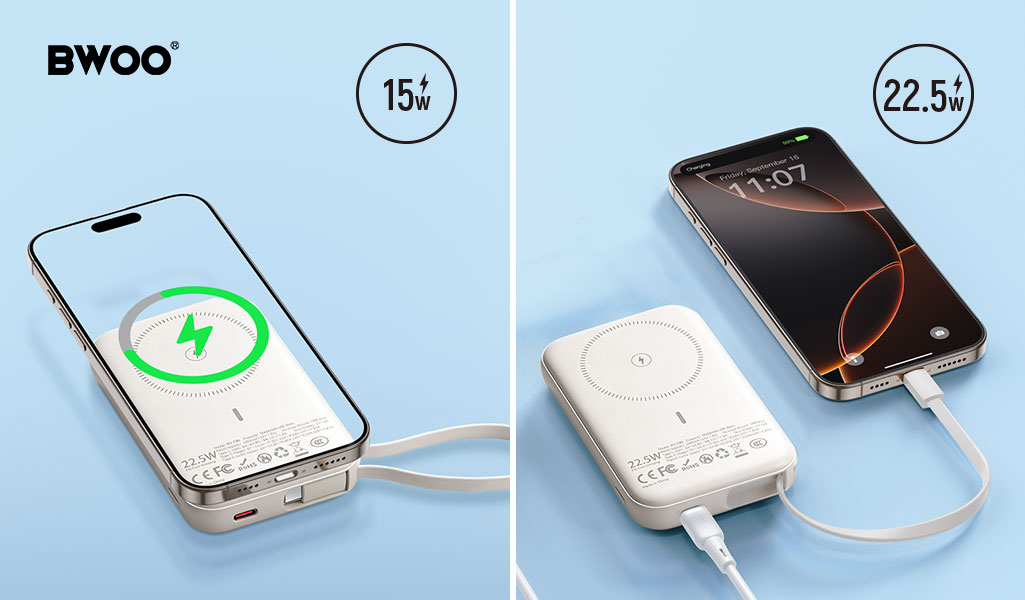
With the launch of Qi2, magnetic wireless charging has rapidly become a new industry standard. More and more power banks, chargers, and smartphones now support magnetic alignment, making "snap-on charging" a seamless daily experience.
However, despite its convenience, one question keeps appearing:
Why is magnetic wireless charging always less efficient than wired charging?
In this article, we take a technical and objective approach to explain the physics behind magnetic wireless charging, analyze the core causes of efficiency loss, and explore where the technology is heading—from both a user experience and a B2B product design perspective.
How Magnetic Wireless Charging Works
1. Electromagnetic Induction: The Fundamental Principle
Magnetic wireless charging is based on electromagnetic induction, governed by Faraday's Law.
The transmitter (TX) coil generates a high-frequency alternating magnetic field.
The receiver (RX) coil inside the smartphone captures part of this magnetic flux and converts it into electrical current.
This induced current is then rectified and regulated to charge the battery.
Unlike wired charging, energy is transferred through space, not through a physical conductor—this difference is the root cause of efficiency loss.
2. The Role of Magnetic Alignment
Magnetic charging does not increase power by itself. Its primary role is geometric alignment:
Embedded magnets force the TX and RX coils to align concentrically.
This improves the mutual inductance between the coils.
A higher mutual inductance increases the coupling coefficient (k), allowing more magnetic flux to be captured.
Without magnetic alignment, even small offsets can reduce charging efficiency dramatically.
3. What Qi2 Changes
Qi2 introduces the Magnetic Power Profile (MPP), inspired by Apple's MagSafe system.
Key improvements include:
Standardized magnet positioning across devices
Better coil alignment consistency
Optimized power negotiation paths
Qi2 improves compatibility and stability, but it does not eliminate the fundamental physical limitations of wireless energy transfer.
Four Core Reasons for Efficiency Loss
1. Limited Coupling Coefficient (k)
Even with perfect magnetic alignment:
There is always an air gap between charger and phone
Phone cases introduce additional separation
Magnetic flux spreads in space, causing magnetic flux leakage
Unlike copper wires, magnetic fields cannot be fully confined, meaning part of the transmitted energy is inevitably lost.
2. Heat Generation and I²R Loss
Wireless charging coils carry high-frequency alternating current.
Loss sources include:
DC resistance (DCR) of the coil
AC skin effect and proximity effect
Eddy losses in nearby conductive materials
This leads to Joule heating, triggering a negative feedback loop:
Temperature rises → semiconductor efficiency drops → phone activates thermal throttling → charging power is reduced
This is why wireless charging often slows down after several minutes.
3. Power Conversion Losses (DC → AC → DC)
Wireless charging requires multiple power conversion stages:
DC input power
Converted to high-frequency AC for the TX coil
Induced AC power in RX coil
Rectified back to DC for battery charging
Each stage introduces:
Switching losses
Gate drive losses
Rectifier losses
In contrast, wired charging typically involves fewer conversion steps, resulting in higher overall efficiency.
4. Eddy Current Loss
When alternating magnetic fields pass through:
Metal phone components
Poorly designed magnetic rings
Inadequate shielding structures
They induce eddy currents, which:
Do not contribute to charging
Convert energy directly into heat
High-quality designs require precise magnetic field control and material selection to minimize these losses.
Market Trends: From Premium Feature to Industry Standard
Trend 1: Universal Adoption of Qi2
Qi2 removes long-standing fragmentation between ecosystems.
As a result, magnetic accessories are transitioning from brand-specific luxuries to standardized components.
Trend 2: Power Levels Moving Beyond 15W
With advances in:
Graphene thermal layers
Heat-spreading structures
Active cooling accessories
Wireless charging is becoming more practical, though still not as efficient as wired solutions.
Trend 3: Magnetic Ecosystems, Not Just Charging
Magnetic interfaces now serve as:
Car mounts
Desktop stands
Cooling attachments
Modular accessory connectors
Charging is becoming part of a larger functional ecosystem.
Ideal Users and Use Scenarios
Business Professionals
Frequent phone interaction, clean desk aesthetics, minimal cable clutter.
Daily Drivers
One-handed operation, automatic alignment, "mount and charge" convenience.
Heavy Content Consumers
Stable landscape viewing angles for streaming, calls, and gaming.
In these scenarios, convenience outweighs peak efficiency.
BWOO's Design Philosophy: Optimizing Within Physical Limits
As a manufacturer specializing in power and charging accessories, BWOO focuses on engineering optimization rather than marketing promises.
High-Q Coil Design
Low-loss materials improve magnetic coupling efficiency without increasing heat.
Active Thermal Monitoring
Built-in NTC temperature sensors dynamically adjust power to maintain safe and stable charging curves.
Magnetic Strength Validation
Gauss-level testing ensures:
Secure attachment
No interference with compasses or internal sensors
Long-term reliability across devices
The goal is not to "beat physics," but to design intelligently within it.
Conclusion:
Magnetic wireless charging is inherently less efficient than wired charging—not due to poor engineering, but due to fundamental physical constraints.
Its true value lies in:
Seamless user experience
Reduced friction in daily use
Integration into multifunctional ecosystems
At BWOO, we offer a diverse range of power bank models, and we are happy to recommend the most suitable power banks to our customers based on the local market needs of wholesalers and retailers. Welcome to contact us!
Related readings:
Can You Use Power Banks on Planes?
2026 Power Bank Market Insight


