






How Many Times Can a 10000mAh Power Bank Charge Your Phone?

2026-01-12 15:46
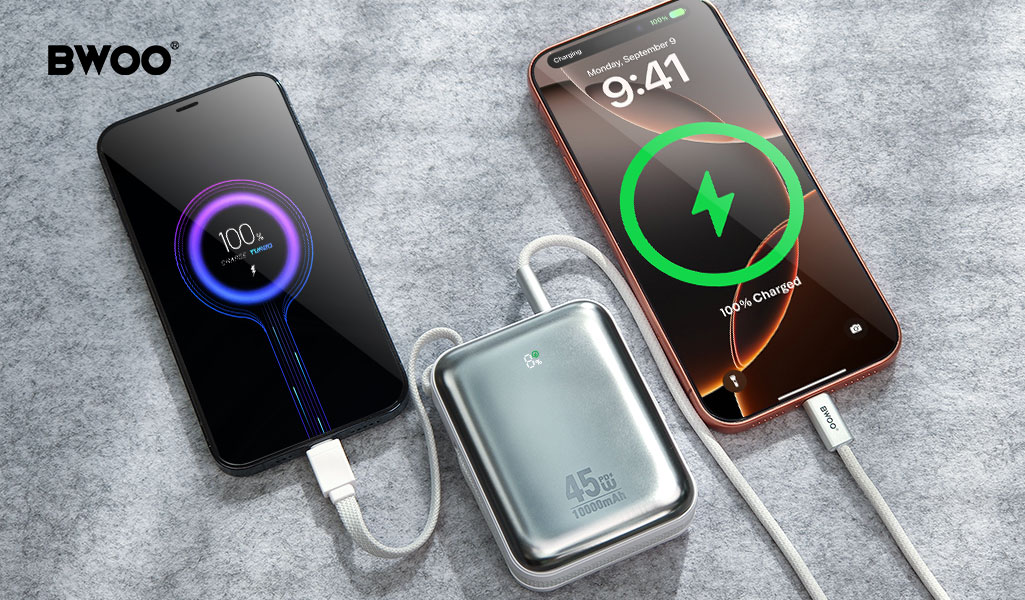
Power banks have become an essential travel companion. When you're on the go—especially during long trips or family outings—a power bank can keep your smartphone alive when wall outlets are nowhere to be found.
However, many users have experienced the same confusion:
A 10000mAh power bank should theoretically charge a 3000–3500mAh smartphone about three times, yet in real life, it usually delivers only around two full charges.
Is this false advertising? Not necessarily.
From the perspective of BWOO, a professional power bank manufacturer, the answer lies in a fundamental but often misunderstood concept: the difference between Cell Capacity and Rated Capacity, and the unavoidable physics behind energy conversion.
This article explains where the "missing" power goes, how to accurately calculate real charging times, and how buyers and B2B partners can identify high-quality power banks by their specifications.
Where Does the "Lost" Power Go? A Technical Breakdown
1. Voltage Conversion Loss (The Core Principle)
The key reason lies in voltage differences.
Power bank lithium cells store energy at ~3.6–3.7V
USB output for phones is 5V, and fast charging often requires 9V or higher
To charge a phone, the power bank must boost voltage through a step-up (boost) circuit.
According to the law of energy conservation:
When voltage increases, available current (and usable mAh) must decrease proportionally.
This means the advertised 10000mAh is measured at 3.7V cell voltage, not at the phone's charging voltage.
2. Conversion Efficiency & Heat Loss
No power conversion is 100% efficient.
Even with premium components, energy is lost as heat during:
DC-DC voltage boosting
Current regulation
Protection circuitry
Industry reality:
Typical conversion efficiency: 80–90%
Lower-end power banks may fall below 80%
BWOO Advantage:
BWOO power banks use high-efficiency synchronous rectification circuits, allowing total energy conversion efficiency to remain above 90% under stable load conditions, minimizing thermal loss and wasted power.
3. Cable & Interface Resistance Loss
Power loss doesn't stop inside the power bank.
Longer cables = higher resistance
Thinner copper conductors = more voltage drop
Poor connectors = additional energy loss
This is why using high-quality, short charging cables matters—especially when fast charging.
The Professional Formula: How to Accurately Calculate Charging Times
To provide transparency, here is the industry-standard calculation formula used by power engineers:
Actual Charges≈(Power Bank Capacity×3.7V×Efficiency)/(5V×Phone Battery Capacity)
Example: iPhone 15
Power bank: 10000mAh
Efficiency: 90% (0.9)
Phone battery: ~3,349mAh
(10,000×3.7×0.9)÷(5×3,349)≈1.99 charges
Conclusion:
Even with top-tier circuitry, charging a modern flagship phone twice is already approaching the physical limit of a 10000mAh power bank.
B2B Buyer Guide: How to Identify a High-Quality Power Bank
1. Check the "Rated Capacity" Label
Professional manufacturers clearly mark Rated Capacity, usually:
6000–6500mAh @ 5V for a 10000mAh power bank
If a product:
Only shows "10000mAh"
Avoids mentioning rated output capacity
…it is often non-compliant or misleading.
2. Ask for Conversion Efficiency Test Reports
Reliable suppliers should provide:
1C constant current discharge test reports
Output capacity data at 5V (and higher voltages if fast charging is supported)
BWOO Commitment:
All BWOO power banks clearly state true rated capacity, use high-density Grade-A polymer cells, and maintain strong capacity retention even after 500 charge cycles.
Why BWOO Power Banks Feel "More Durable" in Daily Use
The difference lies in system-level engineering, not just battery size.
Advanced PCBA Design
Integrated smart power management chips optimize voltage boosting paths and reduce unnecessary conversion loss.
Intelligent Thermal Control
Built-in NTC temperature sensors monitor heat in real time, preventing efficiency drops caused by overheating.
Multi-Protocol Optimization
Support for PD and PPS ensures devices negotiate the most efficient voltage and current combination—reducing wasted energy during fast charging.
Conclusion: Why a 10000mAh Power Bank Delivers About 2 Charges
A 10000mAh power bank stores energy at 3.7V cell voltage, not at the 5V (or higher) required by smartphones.
After accounting for voltage boosting, conversion efficiency, and inevitable heat and cable losses, the usable output is reduced.
The result is clear:
Even under optimal conditions, a high-quality 10000mAh power bank can realistically deliver around two full charges for modern smartphones with large batteries.
This is not a defect—it is the physical limit defined by energy conversion laws.
At BWOO, all power banks are labeled with true rated capacity, engineered with high-efficiency PCBA designs, and tested under real discharge conditions to ensure consistent, predictable performance.
As a professional charging solution manufacturer, BWOO welcomes you to explore our products and technical capabilities. Click here to CONTACT.
Related readings:
Why Is Magnetic Wireless Charging Less Efficient Than Wired Charging?
How to Configure Your Power Bank Shelf by Target Market?


