



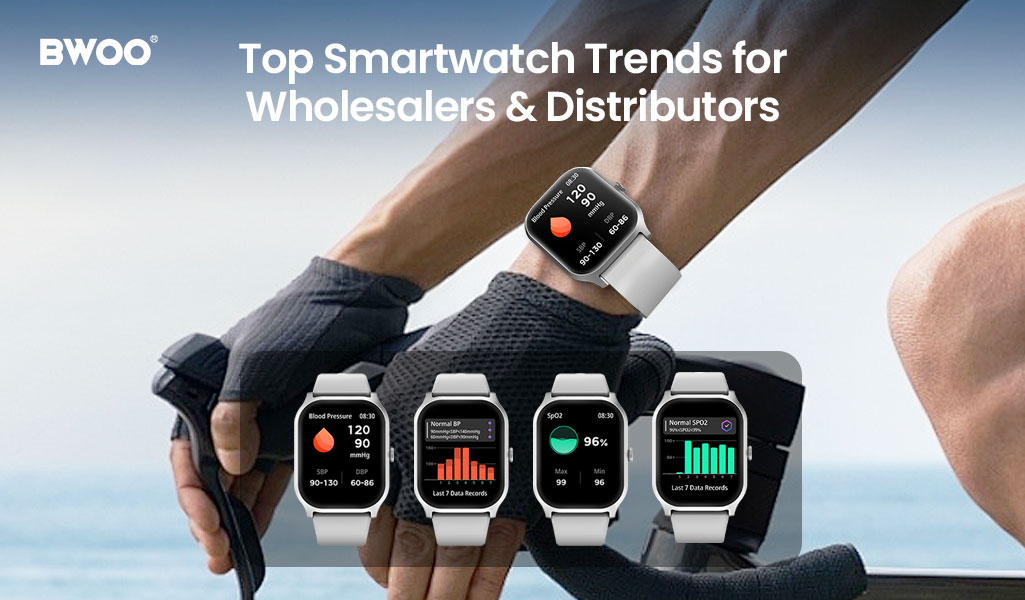
Smartwatches have graduated from fitness toys to health platforms. For a smartwatch wholesale supplier or OEM smartwatch manufacturer, 2026 brings a clear direction: health sensing is the new battleground, and fitness tracker B2B buyers must shift from step-counting to clinical-grade monitoring to stay relevant. This guide maps the trends, the SKU strategy, and the B2B procurement playbook.
2026 Smartwatch Market Trends
Health Sensing Goes Clinical
ECG, blood oxygen (SpO2), and blood pressure monitoring have become table stakes, while glucose monitoring is the emerging frontier. Consumer willingness to pay for health features is highest in North America, Western Europe, and Japan, where preventive health awareness is strong. Wholesalers targeting these markets should prioritize watches with medical-grade sensor arrays and regulatory clearance signals.
Segment Fragmentation
The market has fragmented into four clear segments: fitness/entry ($15-40 FOB, heart rate + step), health/mid ($40-80 FOB, ECG + SpO2), sports/premium ($80-150 FOB, GPS + altimeter + durability), and kids/elder (location + fall detection + SOS). Each segment has distinct certification, feature, and price expectations — a single generic SKU no longer serves any segment well.
MOQ Compression and OEM Flexibility
As the market matures, MOQ trends have compressed: many manufacturers now accept 100-300 unit MOQs for standard smartwatch designs, with OEM/ODM customization (logo, strap, firmware, packaging) available at modest premiums. This lowers the barrier for distributors to launch private-label smartwatch lines.
Smartwatch Segment Comparison
Market Segment | Core Functions | Typical FOB | Target Audience | Key Certifications |
Fitness | Heart Rate/Pedometer/Sleep | $15-40 | General Audience/Fitness Beginners | CE/FCC |
Health | ECG/Blood Oxygen/Blood Pressure | $40-80 | Health-Conscious Individuals | CE/FCC/FDA Preferred |
Sports | GPS/Barometer/Titanium | $80-150 | Outdoor/Athletes | CE/FCC/MIL-STD |
Kids/Elder | Location Tracking/Fall Detection/SOS | $25-60 | Children/Seniors | CE/FCC/Child Safety |
B2B Procurement Strategy
Pick Two Segments, Not All Four
The most profitable distributors specialize in two adjacent segments — for example, fitness + health, or sports + kids/elder. This keeps certification costs, support overhead, and inventory risk manageable while covering complementary demand. Trying to stock all four segments dilutes focus and multiplies compliance complexity.
Certification Is the Hidden Cost
Health features like ECG and blood pressure can trigger additional regulatory scrutiny in some markets. Confirm with your supplier whether a watch's health functions carry the necessary CE/FCC and, where applicable, medical device clearances. Pre-certified models save months and tens of thousands in testing.
Firmware and App Ecosystem
A smartwatch is only as good as its companion app. Choose an OEM smartwatch manufacturer that provides a white-label app or supports integration with major health platforms. App quality directly impacts return rates and long-term brand reputation.
Health Sensor Technology Deep Dive
The sensors inside a smartwatch determine both its cost and its market positioning. PPG (photoplethysmography) sensors — the green/red LEDs on the watch back — measure heart rate and blood oxygen by detecting blood flow under the skin. ECG uses electrodes to measure the heart's electrical signals, a fundamentally different and more clinical measurement. Watches with both PPG and ECG command the health/mid segment premium.
Blood pressure monitoring remains technically challenging; most consumer watches estimate it via pulse wave velocity rather than direct measurement, and accuracy varies. Glucose monitoring is even more experimental — non-invasive optical glucose sensing is still in active research, and buyers should treat marketing claims with healthy skepticism. Understanding these technical limits helps wholesalers avoid over-promising to retailers.
Regional Regulatory Landscape
The EU applies MDR (Medical Device Regulation) to smartwatches making medical claims — even 'tracks heart rate' can trigger scrutiny if marketed as diagnosis. The US requires FDA clearance for ECG and blood pressure features marketed for medical use. Asia-Pacific generally has lighter regulation but evolving rules. Wholesalers should source watches whose health features are either pre-cleared or marketed as wellness, not medical to avoid compliance risk.
Packaging and Private Label Strategy
Private labeling is where smartwatch margins actually materialize. A white-label smartwatch with your brand, custom strap, and tailored packaging can command 30-50% higher retail than an unbranded equivalent. The key is choosing an OEM smartwatch manufacturer that offers low MOQ customization — some now support branded packaging from 100 units — so you can test a private label without huge upfront inventory risk.
Packaging design matters disproportionately in this category. Health-focused buyers respond to clinical, clean packaging with clear sensor callouts and regulatory marks. Avoid over-cluttered sports imagery if you target the health segment. A QR code linking to the companion app on the box also reduces setup friction and return rates.
After-Sales and Firmware Support
Smartwatches are software-defined products — the purchase is just the beginning. Choose a supplier offering OTA firmware updates, a white-label app, and warranty replacement terms (typically 12 months). Firmware quality directly drives return rates: a watch with buggy sleep tracking or sync failures generates complaints regardless of hardware quality.
Also evaluate data export and ecosystem compatibility. Buyers increasingly expect their watch to sync with Apple Health, Google Fit, or Strava. A watch locked into a closed, buggy app limits its appeal and increases returns. Prefer suppliers whose white-label app supports major health platforms out of the box.
Finally, factor sensor calibration into your QC plan. Spot-check a sample batch for heart-rate and SpO2 accuracy against a reference device; consistent readings within a reasonable tolerance indicate quality sensors, while erratic numbers suggest software shortcuts that will surface as complaints.
FAQ
Q1: What smartwatch segment has the highest margin?
Health/mid segment (ECG/SpO2) commands the highest margin relative to FOB, driven by consumer willingness to pay for health features.
Q2: What is the typical smartwatch MOQ for wholesale?
100-300 units for standard designs; OEM customization adds a modest premium.
Q3: Do ECG and blood pressure features require extra certification?
Yes, some markets impose additional scrutiny. Pre-certified models save time and cost.
Q4: How important is the companion app?
Critical. A white-label app or major-platform integration reduces returns and strengthens your brand.
Position your smartwatch line for 2026 growth. Contact Us for BWOO smartwatch samples, white-label options, and segment-specific wholesale pricing.


