



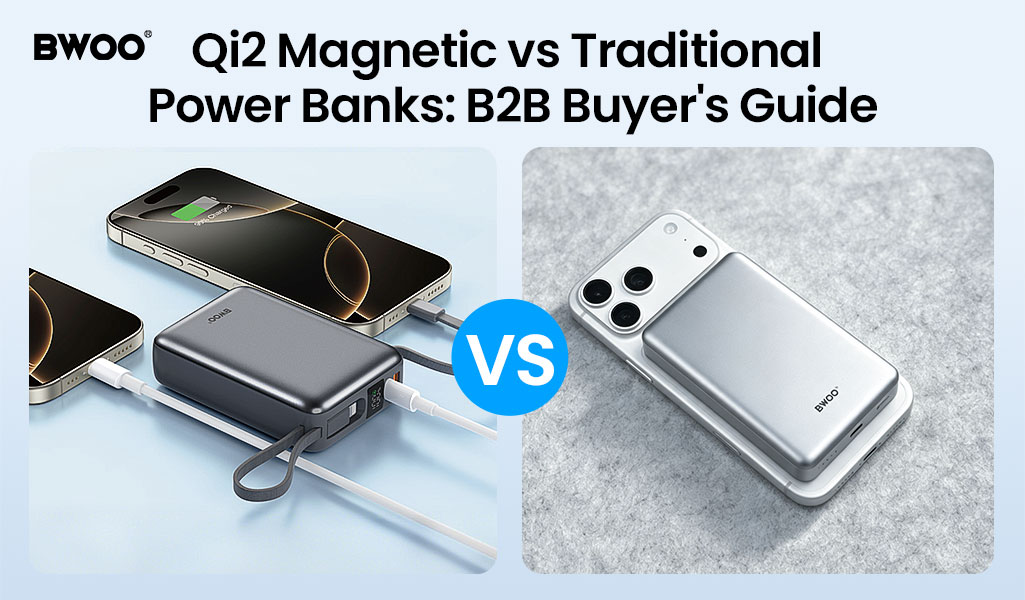
The power bank market is undergoing a transformation. For years, B2B buyers sourcing portable chargers had a simple checklist: capacity, output wattage, number of ports, and price. But with Apple's adoption of Qi2 and the broader industry shift toward magnetic wireless charging, a new category has emerged that demands attention from procurement professionals: Qi2 magnetic power banks. These aren't just traditional power banks with magnets glued on—they represent a fundamentally different charging experience that is reshaping consumer expectations and creating new procurement opportunities.
Magnetic vs Traditional: The Core Differences That Matter for Procurement
At first glance, a Qi2 magnetic power bank and a traditional power bank serve the same purpose: charging your phone on the go. But the user experience, supply chain considerations, and target demographics are entirely different.
Traditional power banks require a cable. The user must carry a USB-C or Lightning cable, find it in their bag, plug it into the power bank and their phone, and manage the dangling wire while using their device. It works, but it's friction-heavy—especially when walking, commuting, or using the phone one-handed.
Qi2 magnetic power banks eliminate the cable entirely for supported devices. Using N52H-grade neodymium magnets and the Qi2 wireless charging protocol, they snap onto the back of a phone with precise alignment. The connection is immediate—no plugging, no fumbling, no cable management. For the end user, the difference is night and day. For B2B buyers, the question is: which experience does your customer base value more?
The Qi2 Technology Advantage: Why It's Not Just 'Wireless Charging'
It's important to understand that Qi2 is not simply Qi with magnets. The Qi2 standard, developed by the Wireless Power Consortium (WPC) and built on Apple's MagSafe technology, introduces several technical advantages that set it apart from both traditional wired power banks and earlier Qi wireless chargers:
15W Certified Fast Charging: Qi2 delivers a full 15W of wireless power to compatible iPhones and Android devices. Earlier Qi chargers often capped at 7.5W for iPhones, making wireless charging painfully slow. Qi2 closes the gap with wired charging, making magnetic power banks genuinely practical for daily use.
Magnetic Precision Alignment: The N52H magnets ensure the charging coil in the power bank aligns perfectly with the receiving coil in the phone every time. Misalignment—the biggest efficiency killer in traditional wireless charging—is virtually eliminated. This means less heat, faster charging, and less wasted energy.
Foreign Object Detection (FOD): Qi2 mandates FOD technology that detects metal objects (keys, coins) between the charger and phone. If a foreign object is detected, charging stops immediately—preventing the overheating and fire risks that plagued early wireless chargers.
Intelligent Thermal Management: Qi2-certified power banks include temperature sensors and dynamic power adjustment. If the device gets too warm, charging wattage automatically reduces to stay within safe thermal limits, protecting both the power bank and the phone's battery health.
Market Trends: Why Qi2 Magnetic Power Banks Are the B2B Growth Category of 2026
Several converging forces are driving explosive growth in the Qi2 magnetic power bank segment:
First, the Apple ecosystem effect. With the iPhone 12 through iPhone 16 series all supporting MagSafe/Qi2, the installed base of magnet-compatible devices now exceeds 600 million units globally. Apple's influence doesn't stop at phones—AirPods with MagSafe cases and the MagSafe accessory ecosystem create a halo effect that drives consumer awareness and demand.
Second, the Qi2 open standard levels the playing field. Unlike proprietary solutions, Qi2 is an open standard that any manufacturer can adopt and certify. This has led to a rapid expansion of Qi2 products from Chinese ODMs/OEMs, creating competitive pricing and diverse form factors that B2B buyers can leverage.
Third, consumer habits are shifting. The inconvenience of carrying and managing cables—especially as more devices adopt USB-C—has made the “snap-and-go” magnetic experience genuinely appealing. Market research indicates that consumers who try magnetic power banks rarely go back to traditional cabled alternatives for their daily carry needs.
Key Procurement Parameters for B2B Buyers
When evaluating Qi2 magnetic power banks for your product line, these technical specifications should be at the top of your checklist:
Magnetic Force (≥800g): The holding force of the magnets determines whether the power bank stays securely attached during use. A minimum of 800g (approximately 8 Newtons) is the industry benchmark for reliable attachment. Anything less, and the power bank may detach when the phone is moved or shaken.
N52H Magnet Grade: N52H is the highest-grade neodymium magnet commonly available. It offers superior magnetic flux density and heat resistance compared to N35 or N48 grades. Always verify—not assume—the magnet grade used.
Qi2 Protocol Certification: Genuine Qi2 certification (not just “Qi2 compatible” claims) ensures 15W charging, proper FOD implementation, and interoperability with all Qi2 devices. Ask suppliers for WPC certification documents.
Battery Capacity and Efficiency: Look beyond the labeled mAh rating. Wireless charging has inherent conversion losses (typically 15-25%). A 5000mAh Qi2 power bank effectively delivers about 3500-4000mAh to the phone. Factor this into your product positioning.
Multi-Device Charging: Some Qi2 power banks offer dual-mode capability—magnetic wireless for one device plus a USB-C port for a second wired device. This versatility can be a key differentiator in retail channels.
Thermal Management System: Verify that the product includes an NTC thermistor for real-time temperature monitoring and dynamic power throttling. This directly impacts safety certifications and product liability.
BWOO Qi2 Product Line: Built for B2B Success
BWOO offers two Qi2 magnetic power banks designed to cover the full spectrum of B2B procurement needs:
BO-P85: Qi2.2 25W 10000mAh — Premium Power User
The BO-P85 is BWOO's flagship magnetic power bank, engineered for the premium segment. With Qi2.2 certification, it delivers up to 25W of wireless charging power to compatible devices—significantly faster than standard Qi2's 15W. The 10000mAh capacity provides approximately 1.8 full charges for an iPhone 16, making it ideal for business travelers, remote workers, and power users who demand maximum performance. The 25W USB-C port also enables wired fast charging for laptops and tablets when needed.
BO-P84: Qi2 15W 5000mAh — Ultra-Portable Everyday Carry
The BO-P84 is designed for the mass-market consumer who values portability above all. At just 5000mAh, it's slim enough to slip into a pocket or small bag while providing one full charge for most smartphones. The Qi2-certified 15W wireless charging is fast enough for daily top-ups, and the N52H magnets ensure reliable attachment. For B2B buyers, the BO-P84 offers an attractive entry price point without compromising on core Qi2 features—making it ideal for corporate gifting, retail bundles, and promotional campaigns.
Both models feature FOD protection, NTC-based thermal management, and comprehensive safety certifications (CE, FCC, RoHS, IEC 62368-1). BWOO provides full B2B support including custom branding, retail packaging design, and flexible MOQ options.
Frequently Asked Questions
Do Qi2 magnetic power banks work with Android phones?
Yes. While Qi2 was initially associated with Apple's MagSafe ecosystem, the Qi2 standard is platform-agnostic. Any Android phone with Qi2 support (including recent Samsung Galaxy, Google Pixel, and Xiaomi flagships) can use Qi2 magnetic power banks. For Android phones without built-in magnets, magnetic adapter rings are widely available and inexpensive.
What is the MOQ for BWOO Qi2 power banks?
BWOO offers flexible MOQ starting from 500 units for standard SKUs and 1,000 units for custom-branded orders. Contact our sales team for detailed pricing and lead time based on your order specifications.
How do I verify Qi2 certification authenticity?
Genuine Qi2-certified products are listed in the WPC (Wireless Power Consortium) certification database. You can search by manufacturer name or product model number. BWOO provides WPC certification IDs with every shipment—never accept uncertified products labeled “Qi2 compatible” without documentation.
Ready to Source Qi2 Magnetic Power Banks?
The Qi2 magnetic power bank category is still in its growth phase, which means early movers have a significant advantage. Whether you're stocking retail shelves, building corporate gift programs, or launching a private-label accessory line, BWOO's BO-P85 and BO-P84 offer certified quality at competitive B2B pricing.
Send an inquiry today for detailed product specifications, sample availability, and volume pricing. Our B2B team will respond within 24 hours with a tailored proposal.


