



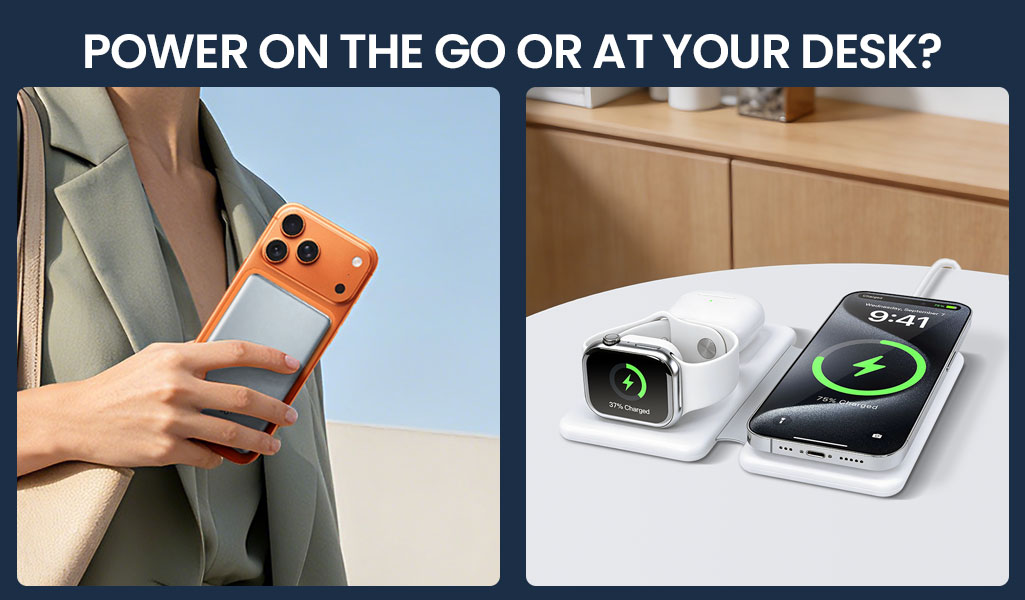
Wireless charging is no longer one product format. A magnetic power bank is designed to travel with a phone, while a multi-device charging station is usually built for a desk, bedside table or shared charging area. Both can use magnetic alignment, but they solve different problems—and they should not automatically compete for the same shelf position.
The distinction has become more visible as brands introduce new charging form factors. On November 4, 2026, Peak Design expanded its lineup with a Qi2.3 portable travel battery, a Qi2.2 wireless charging station and a 65W dual-USB-C GaN wall charger. The announcement illustrates how portable power, fixed multi-device charging and wired wall charging can sit side by side in one accessory range. It does not mean that every magnetic power bank or charging station uses the same Qi generation. (The Verge coverage)
The Core Difference: Power on the Move or Charging in One Place?
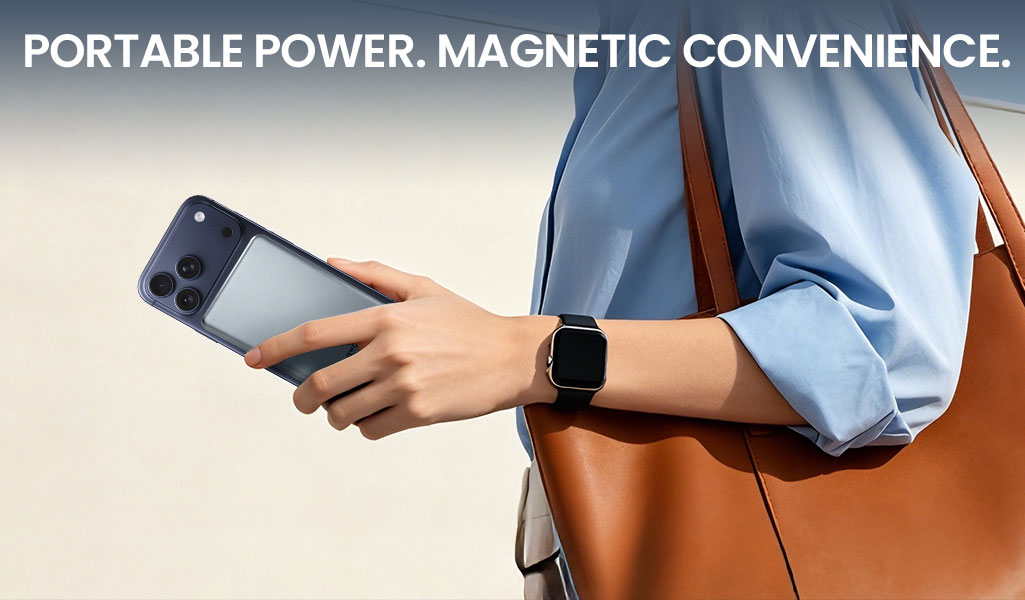
A portable magnetic power bank stores energy in its own battery. The user attaches it to a compatible phone or uses a cable, then carries the power source away from the wall outlet. Capacity, weight, thickness, magnetic alignment and wired output are therefore central buying factors.
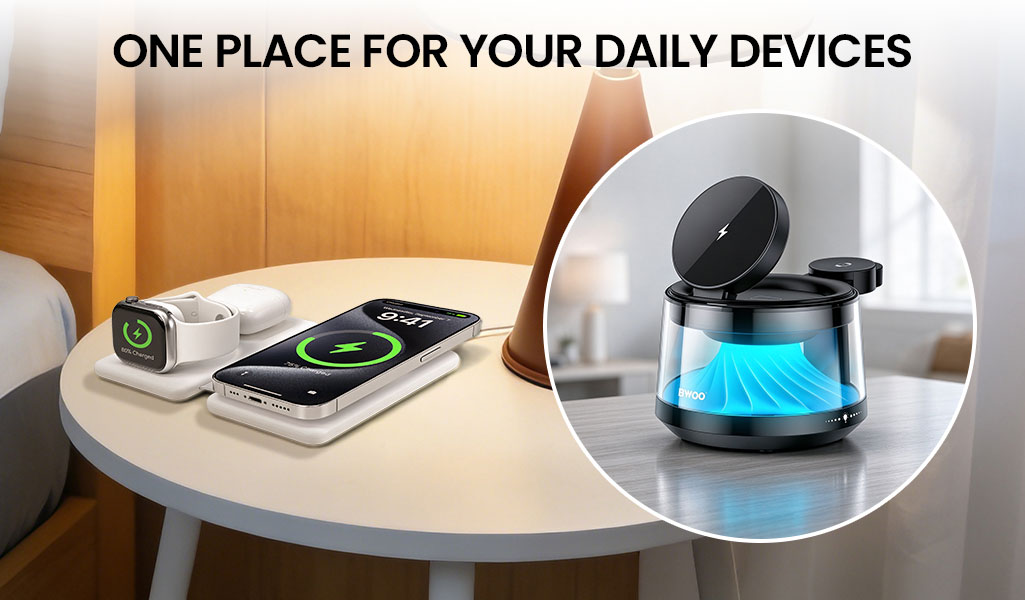
A multi-device wireless charging station is designed to organize charging in a fixed or semi-fixed location. It may charge a phone, smartwatch and earbuds at the same time, depending on its design and device compatibility. Most stations need an external power adapter, and the adapter's output can affect whether all charging positions work as intended.
One is not an upgraded version of the other. A 10,000mAh battery pack cannot be compared directly with a charging stand by counting the number of charging surfaces. The products are built around different usage patterns.
Product Format Comparison for Retail Buyers
Buying factor | Portable magnetic power bank | Multi-device wireless charging station |
Main use | Mobile top-ups during commuting, travel and daily use | Keeping several devices charged at a desk or bedside |
Power source | Built-in rechargeable battery; may also support wired output | Usually a wall adapter or USB power input |
Main specs | Battery capacity, wireless output, wired output, weight and size | Number of charging positions, compatible devices, input requirement and foldability |
User benefit | No wall outlet needed while in use | Less cable clutter and a defined charging location |
Retail role | Everyday carry, travel and phone-accessory aisle | Desk setup, bedside, multi-device and gift-oriented assortment |
Key risk | Capacity/weight trade-off and phone compatibility | Device compatibility, adapter requirement and actual simultaneous charging performance |
What Should Buyers Check Before Choosing a Magnetic Power Bank?
First, distinguish battery capacity from actual delivered charging energy. A capacity printed in mAh is usually based on the battery cell's nominal voltage, while the energy delivered to a phone is affected by conversion losses, temperature and charging conditions. Retail copy should not imply that a 10,000mAh pack will refill every 5,000mAh phone battery exactly twice.
Second, verify the wireless standard and the phone compatibility list. Magnetic attachment does not automatically mean Qi2 certification, and a magnetic-looking product should not be marketed as a certified Qi2 or Qi2.2 device without the appropriate documentation. For buyers who need a standards refresher, BWOO's Qi2.2 guide to 25W magnetic wireless charging explains the charging-standard context.
Third, check the wired charging path. A power bank may support USB-C input, USB-C output, or simultaneous wired and wireless charging, but these functions and their maximum power levels differ by model. Ask for the complete input/output table rather than relying on a headline wattage.
As current BWOO examples, the BO-P85 is listed as a 10,000mAh magnetic power bank with Qi2.2 25W wireless output, while the BO-P84 is listed as a 5,000mAh Qi2 15W magnetic power bank with 20W PD wired output. These are different capacity and charging tiers; do not label both as Qi2.2.
What Should Buyers Check in a Multi-Device Charging Station?
The first question is not how many accessories the product claims to support, but which devices can actually charge at the same time. A “3-in-1” design typically refers to three charging targets, but the watch charger may be a dedicated module, the earbuds pad may have a different output, and the phone pad may be the only magnetic fast-charging position. Ask for a device-by-device compatibility and output table.
The second question is the adapter. A charging station may require a specific minimum input, and using a low-output adapter can cause slow charging or prevent some positions from operating. Check whether the adapter is included, what input rating is recommended and whether the cable is part of the retail package.
The third question is portability versus stability. A foldable station can travel more easily, but a desk model may offer a larger footprint, more features or integrated accessories. Confirm hinge durability, magnetic holding strength, thermal behavior and whether the unit remains stable when a phone is attached.
BWOO's BO-WL24 is listed as a foldable 3-in-1 charging station for a phone, watch and earbuds, with 15W magnetic wireless charging. The BO-WL25 combines a charging station with a wireless speaker and RGB ambient lighting, and is listed to charge three devices simultaneously. BO-WL25's listed magnetic charging output is 15W; it should not be described as a Qi2.2 25W station.
A Practical Retail Assortment: Stock Both, but Give Them Different Jobs
For many mobile-accessory retailers, the two formats work best as complementary items rather than substitutes. A magnetic power bank can serve customers who are away from a desk, while a charging station can serve customers who want a dedicated home or office charging point.
Entry or impulse tier: a compact magnetic power bank for existing smartphone users who want a simple everyday-carry product.
Higher-capacity mobile tier: a larger magnetic power bank for travelers or customers who also need wired output.
Desk and bedside tier: a foldable 3-in-1 station for customers with a phone, watch and earbuds.
Lifestyle/gift tier: a station that adds speaker or ambient-light features, provided those functions are relevant to the target channel.
When testing samples, measure the experience rather than only checking the packaging. Confirm magnetic alignment, charging stability, temperature, real phone compatibility, simultaneous charging and adapter behavior. For Qi standards and magnetic power comparisons, keep the Qi2.1 vs. Qi2.2 upgrade guide as a supporting resource—but avoid repeating its standards explanation in full here.
Conclusion
Portable magnetic power banks and multi-device wireless charging stations solve different charging moments. Retailers should choose the power bank for mobility and stored energy, and the station for an organized multi-device charging point. A balanced assortment can serve both needs, as long as each SKU is positioned by its real capacity, charging standard, compatibility and use case.
FAQ
Is a magnetic power bank the same as a wireless charging station?
No. A magnetic power bank contains a battery for portable use. A charging station is generally designed to charge several devices in a fixed location and usually needs external power.
Does magnetic attachment mean Qi2 certification?
No. Magnetic attachment and Qi2 certification are not interchangeable. Buyers should verify the exact model’s certification status and supported output.
Should a retailer stock a 5,000mAh or 10,000mAh magnetic power bank?
That depends on the target price, weight tolerance and customer use case. A smaller model can suit light daily carry, while a higher-capacity model may suit longer days or travel.
What should be checked before buying a 3-in-1 charging station?
Confirm compatible devices, output at each charging position, adapter requirements, whether the adapter is included, thermal performance and simultaneous charging behavior.
Can a multi-device charging station replace a power bank?
Not for users who need power away from an outlet. A station organizes charging at a location; a power bank stores energy for mobile use.


