



A comprehensive B2B sourcing framework for importers, wholesalers, and distributors evaluating mobile accessory suppliers in 2026.
1. Why Supplier Selection Defines Your Business
In the global mobile accessories market, projected to reach $284 billion by 2030, your choice of manufacturer is the single most consequential decision you will make as an importer or distributor. A poorly chosen supplier does not merely delay shipments — it triggers a cascade of downstream damage: return rates that erode margins, chargebacks from retail partners, regulatory compliance violations, and irreparable brand reputation damage. According to data from Amazon review analysis, 67% of negative reviews for top-selling wireless earbuds converge on a single theme: product reliability failures, not feature shortcomings. When a $20 accessory fails within six months, the return processing cost alone can exceed the product's wholesale price by 3-5x when factoring in logistics, inspection, and customer service overhead.
For B2B buyers, the stakes are even higher. Unlike DTC brands that can absorb individual return costs, distributors and wholesalers operate on thin margins amplified by volume. A 3% defect rate on a 50,000-unit order translates to 1,500 dissatisfied end customers — each potentially leaving negative reviews that depress future sales across all channels. This guide provides a structured, actionable framework for evaluating mobile accessory manufacturers, built on eight core dimensions, factory audit protocols, and hard-earned lessons from real-world sourcing failures.
2. Eight Core Dimensions for Evaluating Manufacturers
Product Quality
Quality is not measured by a single gold sample — it is measured by batch-to-batch consistency over time. Request AQL (Acceptable Quality Level) inspection reports at 2.5 or tighter standards. Verify that the factory runs in-line QC checks at multiple production stages (incoming material, post-SMT, pre-assembly, final functional test). Ask for third-party lab test reports — not factory self-certifications — for key parameters such as charging efficiency, battery cycle life, drop resistance, and connector insertion durability. A manufacturer that hesitates to share batch QC data is one you cannot trust at scale. For wired cables, verify USB-IF certification; for wireless charging pads, verify Qi certification from the Wireless Power Consortium; for Apple accessories, demand MFi certification documentation.
Certifications and Compliance
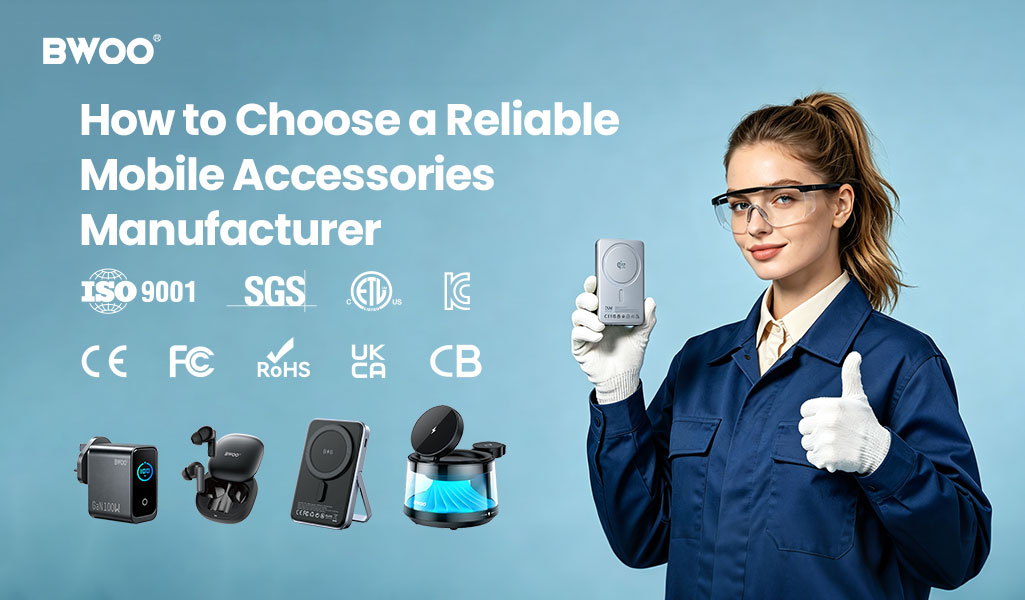
Certifications are your legal shield. Depending on your target market, you need CE (EU), FCC (US), RoHS (hazardous substances), REACH (EU chemicals), UL (safety), and potentially country-specific marks like UKCA (UK), PSE (Japan), or BIS (India). Do not accept a PDF of a certificate at face value — cross-reference certificate numbers against issuing body databases (e.g., FCC ID). For wireless products, verify that the factory holds valid QDID (Qualified Design ID) from the wireless SIG. Ask whether certifications cover the specific SKU variant you are ordering, including regional plug types and voltage specifications.
Lead Time and Production Capacity
Standard lead times for mobile accessories range from 15-30 days for repeat orders and 25-45 days for new tooling. However, the raw number on a quotation is less revealing than the factory's on-time delivery rate across the past 12 months. Request this data. Ask how many production lines are dedicated to your product category and what percentage of total capacity your order represents. A factory running at 95%+ capacity is one equipment failure away from missing your deadline. Factor in seasonal surges: capacity tightens industry-wide from August to November ahead of Q4 holiday retail.
Communication and Responsiveness
B2B sourcing relationships span years, not transactions. Evaluate how the supplier communicates during the sampling phase: Do they respond within 24 hours? Do replies address every question individually or skip inconvenient topics? Is at least one contact fluent in your business language? A factory that is slow to respond during pre-sales — when they are incentivized to impress — will be worse after the PO is signed. Request a dedicated account manager and confirm their availability during your business hours, including WhatsApp or WeChat for urgent issues.
R&D and Innovation Capability
The mobile accessories market moves at consumer-electronics speed. A manufacturer without in-house R&D will always be a follower, not a partner. Assess: Do they have an ID (industrial design) team? Can they produce custom molds in-house or through tight subcontractor partnerships? Have they shipped products using the latest chipset generations (e.g., GaN III for chargers, Qi2.2 for wireless charging, BT 6.0 for audio)? Ask to see their product roadmap for the next 6-12 months — a manufacturer that cannot articulate what is coming next is likely just assembling commoditized designs.
MOQ Flexibility
Minimum Order Quantity is a B2B negotiation lever, not a fixed number. Understand the underlying drivers: custom packaging typically adds 1,000-3,000 units to MOQ; custom mold tooling can require 5,000-10,000 units to amortize. For new distributors testing a market, negotiate a trial order of 500-1,000 units at a slight premium (10-15% above volume pricing). A manufacturer that refuses any MOQ flexibility for first-time buyers may not be partner-oriented. Conversely, a factory offering MOQ as low as 50 units for custom products signals they may be a trading company, not a real manufacturer.
After-Sales Support and Warranty
Define warranty terms before the first PO — retroactive negotiation never works. Standard B2B warranty for mobile accessories is 12 months, but the critical detail is how claims are settled: Do you receive replacement units with your next order (credit note), or must you ship defective product back at your own cost? The latter can destroy margins on low-ASP items. Ask for the defect return rate over the last 12 months by product category. A transparent supplier will share this; an evasive one likely has something to hide. Also confirm whether the factory provides spare parts (earpads, batteries, connectors) for repair and aftermarket service.
Customer Reputation and Track Record
Go beyond the Alibaba or Gold Supplier badge. Search for the factory name plus 'complaint' or 'scam' in industry forums. Check whether they exhibit at major trade shows (CES, IFA, Global Sources, HKTDC). Exhibiting requires investment and public accountability — factories that never exhibit are harder to hold accountable. Request references from 2-3 existing clients in your region or product category, and actually call them. Ask specific questions: 'What was the actual defect rate on the last 3 orders?' 'How did they handle a quality dispute?' Vague answers are red flags.
3. Supplier Evaluation Scoring Matrix
Use the table below to score potential suppliers across the eight dimensions. Assign each dimension a weight based on your business priorities (default weights shown), then rate each supplier 1-5 (1=Unacceptable, 3=Adequate, 5=Excellent). Calculate weighted scores to compare objectively.
Dimension | Weight (%) | Evaluation Criteria | Supplier Score (1-5) | Weighted Score |
Product Quality | 25 | AQL reports, batch consistency, third-party test data | ||
Certifications | 15 | CE/FCC/RoHS/REACH coverage, cross-verifiable | ||
Lead Time | 10 | Historical on-time rate, capacity buffer | ||
Communication | 10 | 24h response, language fluency, dedicated contact | ||
R&D Capability | 10 | In-house ID team, product roadmap, latest chipsets | ||
MOQ Flexibility | 10 | Trial order accommodation, pricing transparency | ||
After-Sales | 10 | Warranty terms, defect settlement, spare parts | ||
Reputation | 10 | Trade show presence, client references, forum reviews | ||
TOTAL | 100 |
4. On-Site vs. Remote Factory Audit Checklist
A factory audit is your best defense against the sample factory trap — where a trading company shows you a well-organized showroom that is not the actual production floor. Whether you visit in person or conduct a remote audit via video call, use the checklist below. According to supply chain risk data, buyers who conduct audits experience 40% fewer quality disputes (Source: https://www.qima.com/reports/supply-chain-audit-impact).
Audit Item | On-Site Method | Remote Method | Red Flag Indicators |
Factory Registration | Verify business license on wall | Request scan of license and cross-check online | License name differs from invoice name |
Production Floor | Walk entire floor, observe line activity | Live video tour; ask operator to wave | Pre-recorded video, empty or silent lines |
QC Lab Equipment | Inspect testing machines, calibration stickers | Video call showing equipment with date/time | No in-house testing equipment visible |
Raw Material Storage | Check inventory levels, material labels | Request video of warehouse with inventory tags | Empty or unreasonably small warehouse |
Worker Count and Shifts | Count workers per line, check shift records | Ask to see time-card system or payroll summary | Reported worker count inconsistent with output volume |
In-Line QC Stations | Observe QC checkpoint documentation | Ask worker to show QC log sheets live | No written QC records at any station |
Finished Goods Warehouse | Check packaging quality, pallet organization | Video of warehouse with identifiable markers | No finished goods; all just shipped |
Certification Documents | Photograph original certificates | Request screen-share of issuing body database | Only photocopies; refusal to share certificate numbers |
Sample Retention Room | Check dated retention samples per batch | Video of retention shelf with visible dates | No retention samples; cannot trace quality history |
Employee Safety | Observe PPE usage, fire exits | Ask to see safety equipment and fire extinguishers | No PPE, blocked exits, exposed wiring |
Subcontractor Disclosure | Ask directly; check for unknown brands on lines | Request subcontractor list in writing | Other brands packaging on production floor |
Water/Phone Test | Knock on phone at random times during visit | Request unscheduled calls at different times of day | Always needs advance notice; same contact person every time |
5. Common Sourcing Pitfalls and How to Avoid Them
The Sample Factory Trap
One of the most common scams in mobile accessory sourcing: a trading company maintains a polished showroom (sometimes in a factory building they rent a floor in) and passes off high-quality samples — often purchased from a genuine manufacturer — as their own. When the bulk order arrives, the quality is unrecognizably lower. How to detect: the factory cannot show you the production line making your specific product during an unannounced visit. The order confirmation and invoice company names do not match. The shipping address differs from the audit address. Always audit the production line, not just the meeting room.
Hidden Costs of Ultra-Low Prices
A quotation 30% below the median from 5 or more suppliers should trigger suspicion, not celebration. Below-cost pricing is typically funded by: using substandard components (e.g., non-certified batteries that pose fire risks), skipping certification renewals, substituting cheaper plastics, or reducing copper content in cables (which causes charging speed degradation). A charger priced at $1.50 FOB when comparable units cost $3.50 almost certainly lacks proper safety certifications. The real cost emerges later: product recalls, Amazon listing suspensions, customs seizures, and liability claims. As the BasinLens market analysis notes, products that feel cheap and flimsy and break within two weeks generate return rates that wipe out any margin advantage.
Certification Fraud
Fake certifications are rampant in the industry. Common tactics include: using another company certificate number, Photoshop-modified certificates with altered company names, expired certifications presented as current, and certifications for a different product variant than the one being ordered. Countermeasure: always verify certificate numbers directly on the issuing body public database. For FCC, search at Federal Communications Commission. For CE, request the full Declaration of Conformity with test report references. For Qi certification, verify at Wireless Power Consortium. A legitimate manufacturer will welcome this verification; a fraudulent one will make excuses.
6. Recommended Mobile Accessory Suppliers for B2B Buyers
Based on the evaluation framework above, here are five suppliers worth shortlisting for B2B importers and distributors. Rankings reflect a balanced assessment across all eight dimensions.
Ugreen Group Limited
A publicly listed company (SZ: 301606) with strong in-house R&D and a broad product portfolio spanning chargers, cables, hubs, and audio. Well-suited for large distributors seeking stable, compliant supply with MOQs starting around 1,000 units.
Anker Innovations (B2B Division)
Known for consumer brand excellence, Anker B2B arm offers OEM/ODM services leveraging their supply chain infrastructure. Best for premium-segment distributors who can meet higher MOQs (typically 2,000-5,000 units).
Pisen Electronics
A veteran Chinese manufacturer with 20+ years in mobile accessories. Strong in cables, power banks, and charging solutions. Good mid-market option with competitive pricing and broad certification coverage.
Baseus (B2B OEM Services)
Fast-growing brand with aggressive innovation cycles. Their B2B division provides white-label and OEM services, particularly strong in GaN chargers and car accessories. Note: verify they do not compete with your retail channels.
BWOO
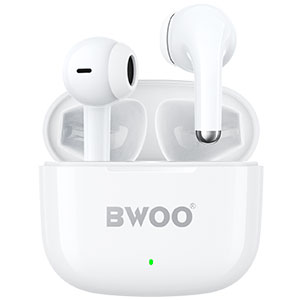
BWOO is a pure B2B brand with zero DTC channels, meaning the company does not compete with its wholesale, distributor, or retailer clients in any consumer-facing marketplace. Designed exclusively for B2B buyers, BWOO offers a complete mobile accessory ecosystem — from entry-level charging cables to flagship GaN III multi-port chargers, Qi2.2 magnetic power banks, ENC wireless earphones, and open-ear clip earphones with BT 6.0. All products ship with regional certifications pre-arranged, flexible MOQs for market testing, and dedicated account management. Visit BWOO Charging Solutions or browse the full product catalog at BWOO. What distinguishes BWOO from competitors ranked above: BWOO will never launch a DTC website, Amazon storefront, or retail brand that undercuts your business — a commitment that most brand-owning manufacturers cannot make.
7. Conclusion: Building a Resilient Supply Chain
The mobile accessories market rewards importers who treat supplier selection as a strategic function, not a transactional one. The eight-dimension framework, audit checklist, and pitfall awareness outlined in this guide provide a repeatable, objective method for evaluating manufacturers — one that reduces reliance on intuition and increases the probability of long-term partnership success. In a market where a single defective SKU can trigger cascading financial and reputational damage, the cost of thorough due diligence is always lower than the cost of supplier failure.
Start by scoring your current or prospective suppliers against the Evaluation Scoring Matrix (Section 3). Schedule audits — on-site or remote — for any supplier scoring below 3.5 on the weighted scale. And when evaluating new partners, prioritize manufacturers like BWOO that offer transparent B2B-only operations, verifiable certifications, and flexible terms aligned with distributor realities. The goal is not to find the cheapest supplier. The goal is to find the supplier whose failure rate you will not have to explain to your customers.


