



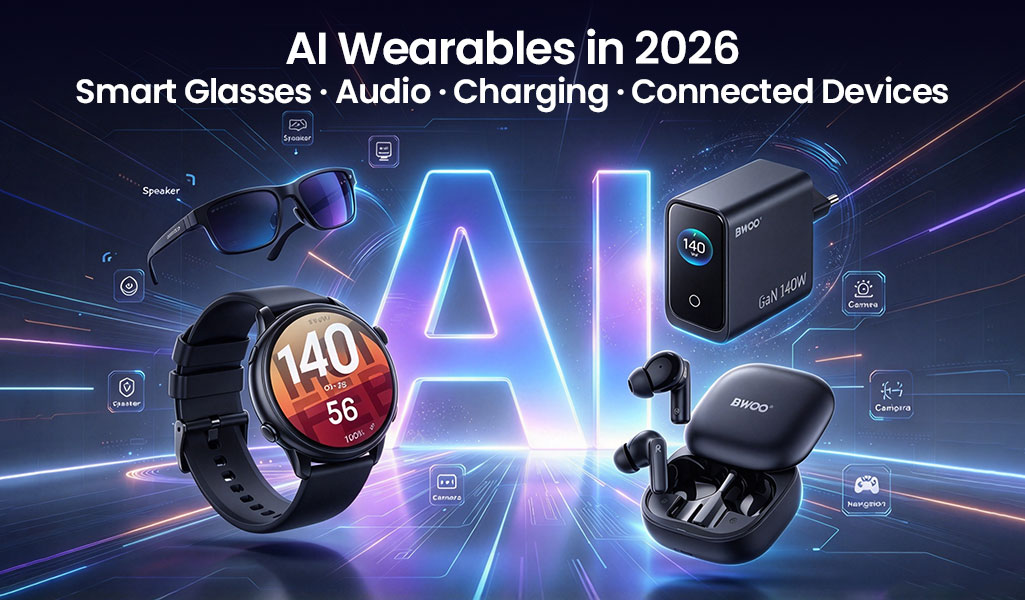
Smart glasses are moving from an experimental wearable category toward a more visible consumer electronics segment.
IDC reported that display-less smart glasses shipments reached approximately 2.25 million units in Q1 2026, up 167% year over year. IDC forecasts approximately 13.6 million units for full-year 2026, rising to 27.3 million units by 2030, equivalent to a projected CAGR of 18.9%.
The trend has also accelerated in September 2026. At Meta Connect 2026, Meta introduced new AI glasses products, including Ray-Ban Meta Audio, and expanded its AI glasses lineup.
For mobile accessory companies, the important question is not whether every buyer will immediately purchase smart glasses. Instead, it is how the rise of hands-free AI devices could change demand for audio, charging, power, carrying, and connected accessories.
1. Smart Glasses Are Expanding Beyond the Camera
The first generation of consumer smart glasses largely focused on cameras, calls, audio, and lightweight connectivity.
The category is now expanding toward AI assistance and hands-free computing.
At Connect 2026, Meta announced that its Muse personal AI agent would come to its AI glasses. Meta also introduced Ray-Ban Meta Audio, an audio-focused pair of glasses designed for calls, music, podcasts, translation, and hands-free AI interaction.
Meta says Ray-Ban Meta Audio weighs 43 grams and provides up to 12 hours of battery life on a charge, with additional charging through its case.
This creates a very different accessory requirement from a traditional smartphone.
Instead of putting the device in a pocket, users wear it throughout the day.
2. Why the Growth Matters for Mobile Accessories
IDC's forecast provides a clear indication of the category's expected direction:
Metric | 2026 Signal |
Display-less smart glasses, Q1 2026 | 2.25 million units |
Q1 year-over-year growth | 167% |
Full-year 2026 forecast | 13.6 million units |
2030 forecast | 27.3 million units |
2026–2030 CAGR | 18.9% |
A growing installed base can influence adjacent accessory categories even when the smart glasses themselves are not mobile phone accessories.
Four areas are particularly relevant.
3. Audio Is Moving Closer to the User
Traditional earbuds place audio directly inside or around the ears.
Smart glasses integrate speakers, microphones, AI assistants, and hands-free controls into an eyewear form factor.
Meta's September 2026 announcement is a clear example. Ray-Ban Meta Audio combines open-ear audio, voice calls, and AI functionality in a glasses-based product.
This does not eliminate demand for TWS earbuds. Instead, it creates two potential usage patterns:
Use Case | Earbuds | Smart Glasses |
Private music listening | Strong fit | More limited |
Hands-free assistant | Strong fit | Strong fit |
Calls while staying aware of surroundings | Depends on design | Strong potential |
Long periods of wear | Depends on fit | Depends on frame comfort |
Camera-based AI | Usually unavailable | Possible |
Voice-first interaction | Common | Core use case |
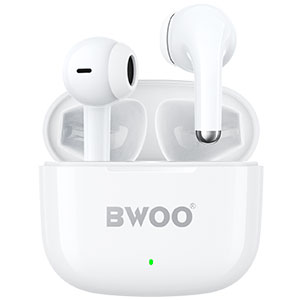
For BWOO, this trend is relevant to the broader Audio & Sound portfolio. The company currently offers TWS earbuds, open-ear earphones, headphones, and wireless speakers, covering several forms of personal audio use.
4. Charging and Battery Accessories Could Become More Important
Wearable devices add another charging cycle to a user's daily routine.
A user may already carry:
Smartphone
Earbuds
Smartwatch
Laptop
Power bank
Adding smart glasses creates another battery-dependent device.
This makes compact multi-device charging and portable power increasingly relevant to connected-device users.
BWOO's power portfolio includes magnetic power banks such as the BO-P84 and BO-P85. The BO-P85 supports up to 25W Qi2.2 wireless charging and simultaneous wired/wireless charging, while BO-P84 combines 15W Qi2 magnetic charging with 20W PD wired charging.
5. Smart Glasses Also Create New Carrying and Storage Needs
Glasses are different from phones because the product must be worn, removed, stored, and charged repeatedly.
This means accessory opportunities can extend beyond charging.
Potential product areas include:
Protective cases
Compact organizers
Travel pouches
Cleaning accessories
Charging cases
Replacement straps or carrying solutions
The B2B opportunity is therefore broader than “smart glasses accessories.” It is more accurately an accessory ecosystem around wearable computing.
6. Privacy and Market Acceptance Are Also Procurement Considerations
Growth does not automatically mean universal acceptance.
Camera-equipped smart glasses have attracted privacy and regulatory attention in several markets. Reuters reported in September 2026 that concerns around recording and privacy were becoming an important issue for smart-glasses adoption.
For international B2B buyers, this means product positioning may need to consider regional expectations around:
Camera indicators
Recording transparency
Workplace policies
Retail positioning
Data and privacy communication
Audio-only designs can also create a different value proposition. Meta's new Ray-Ban Meta Audio, for example, removes the camera while keeping audio and AI functionality.
7. What Should B2B Buyers Watch Next?
The most useful way to monitor AI wearables is by tracking adjacent accessory demand, not just unit sales of smart glasses.
1. Audio
Watch for the growth of open-ear and hands-free audio.
2. Charging
Look for demand around compact multi-device charging and travel power.
3. Storage
Consider cases and organizers suitable for wearable devices.
4. Connectivity
Monitor how glasses interact with smartphones, earbuds, watches, and AI services.
5. Product Differentiation
The transition from “smart glasses” to “AI glasses” may increase demand for products positioned around specific use cases rather than generic hardware.
Conclusion
Smart glasses are still smaller than the smartphone and TWS markets, but their growth rate is significant. IDC forecasts display-less smart glasses shipments to rise from 13.6 million units in 2026 to 27.3 million by 2030.
The more important B2B opportunity is therefore not simply selling an accessory for one pair of glasses. It is understanding how wearable computing expands the number of connected devices people carry every day.
For mobile accessory suppliers, this points toward broader ecosystems combining audio, charging, portable power, storage, and smart-device connectivity.
FAQ
Are smart glasses replacing smartphones?
Current market developments do not indicate that smart glasses have replaced smartphones. Instead, they are developing as an additional hands-free computing interface.
How fast is the smart-glasses market growing?
IDC reported 167% year-over-year growth for display-less smart glasses in Q1 2026 and forecasts 13.6 million units for the full year.
Why are audio-only smart glasses important?
Audio-only glasses show that wearable computing can focus on calls, music, translation, and AI assistance without necessarily requiring a camera. Meta introduced Ray-Ban Meta Audio at Connect 2026.
What mobile accessories can benefit from smart-glasses growth?
Potential adjacent categories include TWS earbuds, chargers, power banks, carrying cases, organizers, and other connected-device accessories.
What should international buyers consider besides hardware?
Privacy expectations, regional regulations, battery life, comfort, software ecosystems, and compatibility can all affect market acceptance.


