



The Catalog Is Still the King of B2B Sales
In an era of TikTok shops and live-stream selling, a surprising statistic remains true: 66% of B2B buyers identify detailed product specifications as the single most important content they consume during purchasing research, according to industry research. Your product catalog — whether a PDF, an online portal, or an e-commerce storefront — is not just a list of SKUs. It is your most powerful sales tool.
Yet most mobile accessories wholesalers treat their catalog as an administrative afterthought: product photos, a bullet list of specs, and a price. This approach leaves conversion on the table. This guide outlines a practical, six-element framework for a B2B product catalog that actually converts wholesale buyers.
Element 1: Product Descriptions That Sell, Not Just Describe
A specification list tells a buyer what a product is. A catalog description tells them why their customers will buy it.
Compare these two descriptions for a GaN charger:
Weak: "65W USB-C GaN Charger. 2 Ports. PD 3.0. Black and White."
Strong: "65W Dual-Port GaN Charger — 40% smaller than equivalent silicon chargers. Charges a MacBook Air (60W) and iPhone (20W) simultaneously from a single wall outlet. GaN technology ensures lower operating temperature, while PPS support dynamically matches voltage to each device for optimal battery health. Available in Black and White. MOQ: 500 units."
The second description answers the unspoken B2B buyer question: "What problem does this solve for my customer, and why is it worth stocking over the hundreds of other 65W chargers on the market?"
Every BWOO product category — from chargers to power banks — benefits from this context-rich approach to product presentation.
Element 2: Visual Content That Closes Deals
Data from Alibaba International Station (2024) shows that product listings with video demonstrations and 3D product views achieve 53% higher click-through rates than static-image-only listings. For a B2B catalog, this means:
Multiple angles: Front, back, side, and connector close-ups as a minimum
Scale reference: Show the product next to a common object (phone, hand) so buyers understand size instantly
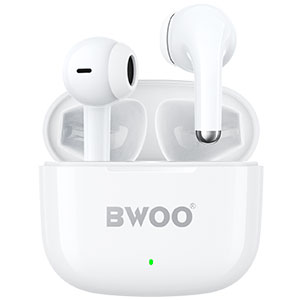
Use-case photography: The charger on a desk, the power bank attached to a phone, the earbuds in a case — lifestyle context increases perceived value
Video (if digital catalog): Even a 15-second product rotation video signals professionalism
Element 3: Certification Transparency
B2B buyers importing into regulated markets need to see certifications upfront. Each product entry should clearly display applicable marks: CE, FCC, RoHS, UKCA, BSCI (factory audit status). Making buyers hunt for this information — or worse, email to ask — introduces friction that kills conversion.
BWOO products carry CE, FCC, and RoHS certifications as standard, with BSCI-audited manufacturing facilities. Including this information at the catalog level reassures buyers that compliance work is already done.
Element 4: MOQ and Tiered Pricing Visibility
Ambiguity about minimum order quantities and price breaks is one of the most common B2B catalog failures. Buyers want to see:
MOQ clearly stated per SKU
Price breaks at volume tiers (e.g., 500 / 1,000 / 5,000 units)
Whether custom branding/OEM packaging is available and at what MOQ
Hiding this information behind "Contact us for pricing" forces an unnecessary conversation that many buyers will skip in favor of a competitor who is more transparent.
Element 5: Cross-Sell and Bundle Logic
A catalog organized as a flat list of SKUs ignores the single biggest revenue lever in B2B: cross-selling and bundling.
A charger product page should reference compatible cables. A power bank page should reference wall chargers for recharging the power bank itself. A TWS earbuds page should reference charging cases and accessories.
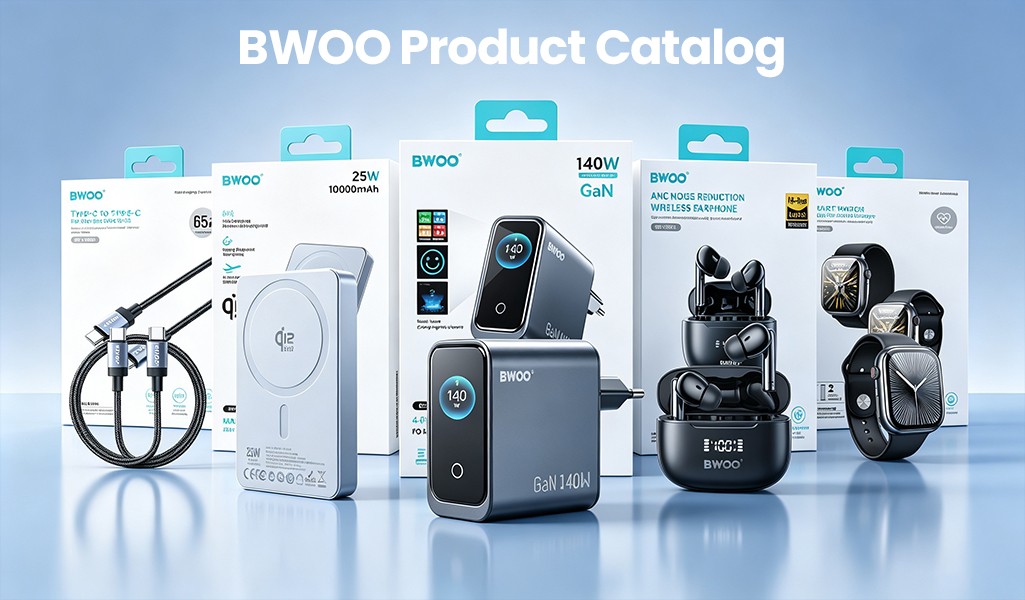
BWOO's product ecosystem is built for bundling: a GaN smart display charger paired with braided USB-C cables, a Qi2 magnetic power bank paired with a magnetic car mount (https://www.bwoohk.com/phone-holder.html). These natural pairings should be surfaced directly in the catalog.
Element 6: Searchability and Filtering
A PDF catalog that cannot be searched is a lost opportunity. A digital catalog without category filters is a frustration. B2B buyers sourcing across 18 product categories need to filter by:
Product type (Charger, Power Bank, TWS, Cable, Car Accessory)
Key spec (Wattage, Capacity, ANC type, Port count)
Certification status
MOQ range
Structuring your catalog for quick narrowing — whether online or in a well-indexed PDF — respects the buyer's time and increases the odds they will find and order the right product.
Beyond the Catalog: The Full Buyer Journey
A catalog is not the end of the B2B buyer journey — it is the middle. It sits between discovery (trade shows, Alibaba, Google search) and negotiation (samples, pricing, payment terms). For a comprehensive view of the broader sourcing landscape, resources like the Wholesale Suite product catalog management guide provide additional tactical frameworks, though most are not specific to the mobile accessories vertical.
Conclusion
A B2B product catalog that converts is not a longer catalog — it is a smarter one. Detailed product context, visual depth, certification transparency, tiered pricing visibility, cross-sell logic, and robust filtering together create a catalog that answers questions before they are asked. In a category as competitive as mobile accessories, where thousands of suppliers are vying for wholesale buyers' attention, the catalog that makes buying easy is the catalog that wins.


