




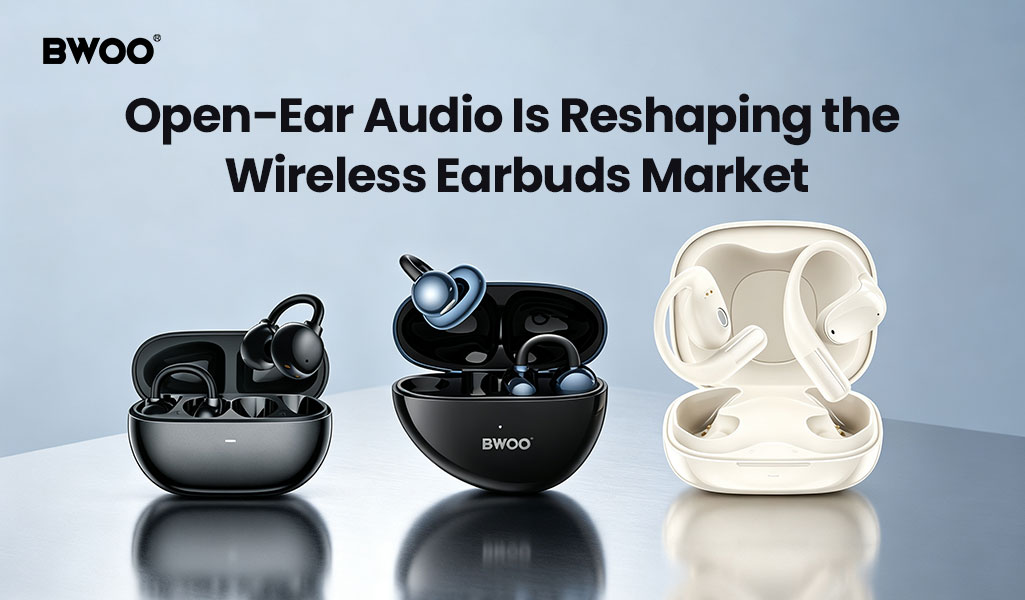
The wireless earbuds market is being reshaped by a category that did not exist in most distributor catalogs five years ago: open-ear audio, also known as OWS (Open Wearable Stereo). With a projected market size of 3.59 billion by 2030 and a CAGR of 8.34 Air Conduction vs. Bone Conduction: Two Technologies, Two Supply Chains.
How Each Works?
Bone conduction: drivers vibrate against the skull to transmit sound directly to the inner ear, by passing the ear drum entirely. The technology’s core advantage is that it leaves the ear canal completely open, making it the safest option for runners, cyclists, and outdoor workers who need situational awareness. The trade-offs: reduced bass response, sound leakage at higher volumes, and the vibration sensation that some users find uncomfortable during extended wear.
Air conduction OWS: place a small speaker driver just outside the ear canal, directing sound inward without sealing the ear. This approach delivers fuller frequency response than bonne conduction(especially in the 60-200Hz bass range)and, with directional audio algorithms shipping in 2026 chip sets, achieves significantly lower sound leakage. For most distributors, air conduction OWS represents the easier entry point: broader consumer acceptance, more supplier options, and higher average selling price.
The Wholesale, Margin Advantage OWS earbuds carry a structural margin advantage that traditional in-ear TWS cannot match:
Metric | Traditional TWS (In-Ear) | OWS (Open-Ear) |
Return Rate (Fit Issues) | Higher | Lower (No ear seal stress) |
Warranty Claim Rate | Higher (Battery + fit issues) | Lower |
Average Selling Price (2026) | $8–12 | Higher ASP |
Wholesale Price Range | $18–45 (Wholesale) | $28–65 (Wholesale) |
Channel Breadth | Consumer Electronics | Consumer + Sports + Corporate |
Market Opportunity | Mature but highly competitive | Expanding into new scenarios and premium segments |
APAC and Middle East Distribution
Markets with hot, humid climates — Southeast Asia, South Asia, the Gulf states — drive disproportionate open-ear adoption. In-ear buds become uncomfortable when the ear canal sweats. OWS solves this natively and commands consistent reorder demand from regional distributors in these markets.
BWOO Open-Ear Audio Product Line
BWOO's audio product line includes both open-ear and traditional form factors to support multi-channel distributor portfolios:
OWS Air Conduction Earbuds: Earhook design with 13mm dynamic drivers, directional audio leakage reduction, IPX5 water resistance, and 8-hour playback — targeting fitness and APAC distribution channels.
BO-BW591 ANC Over-Ear Headphones: 40mm drivers, hybrid active noise cancellation, 30-hour battery life in ANC mode, foldable design for travel retail — available for brand distributors and OEM clients.
ENC TWS Earbuds: In-ear traditional TWS with environmental noise cancellation for calls, targeting corporate and e-commerce channels where call quality is the primary purchase driver.
Distributor samples, wholesale pricing, and OEM/ODM options are available at BWOO official website.
Conclusion
Open-ear audio is the TWS market's highest-growth sub-segment, and the conditions favoring it — hybrid work, outdoor fitness culture, hot-climate markets — are not cyclical trends. They are structural shifts in how consumers use personal audio. Distributors who build an OWS catalog now, before the category reaches saturation, will capture the margin window and the channel relationships that late entrants will find harder to claim. For open-ear audio B2B buyers, the priority is securing a supplier with both OWS and traditional TWS lines so a single partnership covers fitness, corporate-gift, and APAC distribution channels.


