

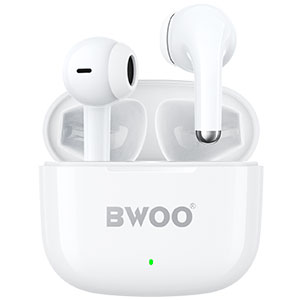


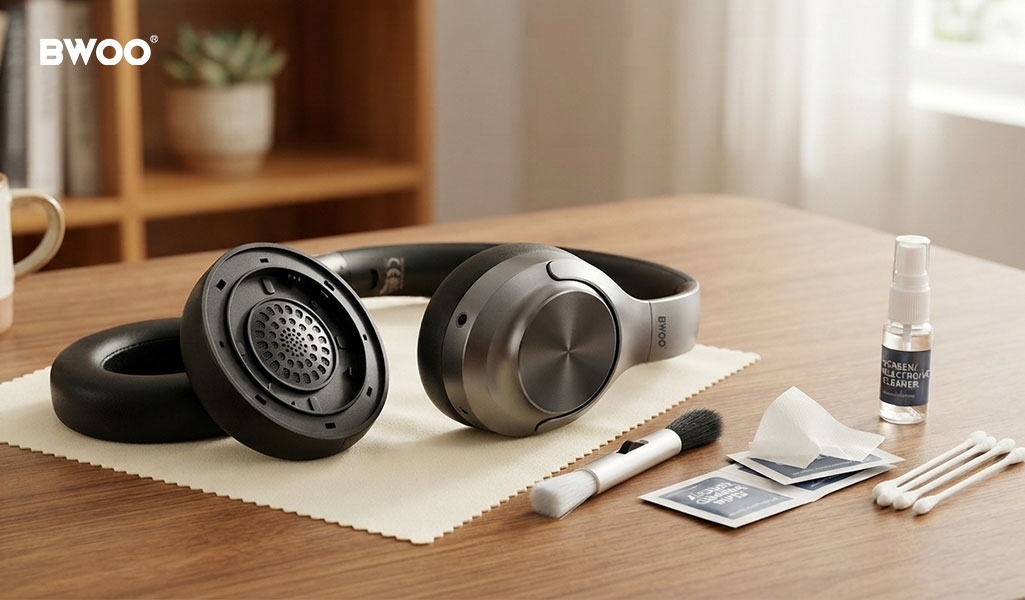
Wireless earbuds have become an everyday essential—whether you are taking calls during your commute, listening to podcasts at the gym, or blocking out cafe noise with ANC while you work. But unlike your phone, which you instinctively wipe clean, earbuds live in one of the dirtiest environments imaginable: your ears. Earwax, sweat, dust, and skin oils accumulate on your earbuds daily, degrading sound quality, reducing battery life, and in the worst cases, causing ear infections.
This guide covers proper cleaning techniques for every type of wireless earbud design, the maintenance habits that extend battery lifespan, and the common mistakes that do more harm than good. Whether you own in-ear ANC buds, over-ear headphones, or open-ear clip designs, a few minutes of weekly maintenance can add months to your earbuds' lifespan.
Why Cleaning Your Earbuds Matters
Beyond hygiene, dirty earbuds suffer from three performance problems that worsen over time:
Sound quality degradation: Earwax buildup on the speaker mesh acts as a physical barrier, muffling high frequencies and reducing overall volume. What sounds like a dying driver is often just a clogged mesh that takes 30 seconds to clean. If your earbuds suddenly sound quiet or tinny in one ear, check the mesh before assuming hardware failure.
Charging connection issues: Dirt and oils on the charging contacts of the earbuds and charging case create resistance that prevents proper charging. The result: earbuds that show as charging but drain quickly because the connection was too poor to deliver full power. Clean charging contacts are as important as clean charging ports.
Bacterial growth: A 2023 study found that uncleaned earbuds harbor an average of 120,000 CFU (colony-forming units) of bacteria per square centimeter—more than a toilet seat. For in-ear designs that sit inside the ear canal, this bacteria transfers directly to your skin, potentially causing otitis externa (swimmer's ear) and other infections.
How to Clean Different Types of Wireless Earbuds
Cleaning technique varies by earbud design. Using the wrong method can push debris deeper or damage delicate components:
In-Ear Earbuds (BO-BW52, BO-BW41)
In-ear designs with silicone ear tips are the most common type and the easiest to clean thoroughly.
Step 1—Remove the ear tips: Gently pull the silicone tips off the earbud nozzle. Wash them with warm water and mild soap, then let them air dry completely before reattaching. Do not use alcohol on silicone tips—it degrades the material over time, causing cracking and loss of flexibility.
Step 2—Clean the speaker mesh: Use a dry, soft-bristled brush (a clean toothbrush works perfectly) to gently sweep away debris from the mesh. For stubborn wax, use a small amount of 70% isopropyl alcohol on a cotton swab—but squeeze out excess liquid first. Never use a pin or sharp object; you will puncture the mesh.
Step 3—Wipe the body: Dampen a microfiber cloth with 70% isopropyl alcohol and wipe the entire earbud body, paying special attention to the charging contacts on the bottom. Dry immediately with a clean cloth.
Over-Ear and On-Ear Headphones (BO-BW591)
Over-ear headphones require different care because their ear cushions absorb sweat and oils over time—unlike replaceable silicone tips, ear cushions are part of the headphone structure.
Step 1—Clean ear cushions: Mix a small amount of mild detergent with water. Dampen a cloth with the solution (not wet—wring thoroughly), then gently wipe the ear cushion surfaces. Follow immediately with a dry cloth. For leather or protein leather cushions, apply a small amount of leather conditioner every 3-4 months to prevent cracking.
Step 2—Clean the headband: The headband padding absorbs hair oils and sweat. Use the same damp-cloth method, and pay attention to the adjustment mechanism—dust and debris in the sliding rails can cause stiffness over time.
Step 3—Driver exterior: Never attempt to clean inside the driver housing. Over-ear drivers are protected by acoustic fabric that should not be touched. If you notice sound quality changes in over-ear headphones, the issue is rarely dirt on the driver—it is more likely ear cushion compression affecting the acoustic seal.
Open-Ear and Clip-On Earbuds (BO-BW99)
Open-ear designs like the BO-BW99 sit outside the ear canal, making them inherently more hygienic—they do not accumulate earwax. However, they still collect sweat, skin oils, and environmental dust.
Cleaning method: Wipe the entire earbud—including the speaker grille area, clip mechanism, and charging contacts—with a microfiber cloth lightly dampened with 70% isopropyl alcohol. The clip hinge area deserves special attention; accumulated debris in the hinge can cause the clip to lose tension over time. Dry thoroughly before placing in the charging case.
Battery Maintenance: Extending Earbud Lifespan
Wireless earbud batteries are their life-limiting component. With proper care, most earbud batteries last 2-3 years at full capacity; poor habits can reduce this to 12-18 months. Key practices:
Avoid deep discharges: Lithium-ion batteries degrade fastest when fully drained. Aim to charge when battery drops to 20-30%, not 0%. Modern earbuds enter low-power mode automatically, but habitually running them to empty shortens total battery lifespan.
Do not leave earbuds in a fully charged case for weeks: Keeping lithium-ion batteries at 100% charge for extended periods accelerates chemical aging. If you are not using your earbuds for more than a week, let the case discharge to 50-70% before storage.
Keep charging contacts clean: As mentioned above, dirty contacts create resistance. The charging circuit compensates by running longer charge cycles—which generates more heat and stresses the battery. A quick wipe of the contacts every 2-3 weeks prevents this cascade.
Common Cleaning Mistakes That Damage Earbuds
Mistake 1—Using compressed air on speaker mesh: High-pressure air can rupture the delicate speaker diaphragm or drive debris deeper into the housing. Stick to soft brushes and gentle wiping.
Mistake 2—Submerging earbuds in water: Even IPX7-rated earbuds are rated for fresh water immersion in laboratory conditions—not soapy water, salt water, or ultrasonic cleaning. The IP rating degrades over time as seals wear. Never intentionally submerge your earbuds for cleaning, even if they are "waterproof.
Mistake 3—Using hand sanitizer instead of isopropyl alcohol: Hand sanitizers contain glycerin and other moisturizing agents that leave a sticky residue on earbud surfaces. This residue attracts more dirt and can seep into microphone ports. Use pure 70% isopropyl alcohol, applied to a cloth—never directly to the earbud.
Mistake 4—Wearing earbuds immediately after swimming or showering: Even waterproof earbuds have a drying period before their seals fully recover. Moisture trapped in the ear canal after swimming creates an ideal environment for bacterial growth if earbuds are inserted immediately. Wait 15-20 minutes after water exposure.
BWOO Wireless Earbuds: Built for Long-Term Use
BWOO's wireless earbud lineup spans every design category, each engineered for durability and easy maintenance:
Model | Type | Key Feature | Water Resistance | Ear Tip Material |
BO-BW52 | In-Ear ANC | Active Noise Cancellation, 4-Mic ENC | IPX5 | Replaceable silicone (3 sizes included) |
BO-BW41 | In-Ear ENC | Environmental Noise Cancellation for calls | IPX5 | Replaceable silicone (3 sizes included) |
BO-BW591 | Over-Ear ANC | Bluetooth 6.0, 40mm drivers, 60hr battery | IPX4 | Protein leather cushions (replaceable) |
BO-BW99 | Open-Ear Clip | 12mm drivers, lightweight 5.2g per bud | IPX5 | N/A—open-ear design, no tips |
All BWOO earbuds include spare ear tips (where applicable), a cleaning cloth in the box, and a quick-start maintenance guide. Replacement ear tips are available in multipacks from bwoohk.com, and BO-BW591 ear cushions are sold as a separate replacement part—extending your headphones' lifespan to 5+ years with proper care.
Frequently Asked Questions
Q: How often should I clean my wireless earbuds?
A: Light cleaning (wiping exterior, checking mesh): weekly. Deep cleaning (removing ear tips, detailed mesh brushing): every 2-4 weeks, or immediately if you notice sound quality changes. If you use earbuds during workouts, clean after every gym session—sweat accelerates buildup.
Q: Can I use alcohol wipes to clean my earbuds?
A: 70% isopropyl alcohol wipes are safe for plastic and metal earbud bodies. Do not use on silicone ear tips (causes degradation) or leather ear cushions (dries out the material). Avoid bleach-based wipes entirely—they corrode charging contacts.
Q: Why does one earbud drain faster than the other?
A: Uneven battery drain often indicates dirty charging contacts on the faster-draining earbud. If the case cannot establish a clean electrical connection, that earbud charges incompletely. Clean both the earbud contacts and the case pins, then test again. If the issue persists, the battery itself may be aging.
Q: How long should wireless earbuds last?
A: With proper cleaning and battery care, quality earbuds should last 3-4 years before battery capacity drops below 70%. Ear tips should be replaced every 3-6 months (they lose elasticity and seal). Over-ear cushions should be replaced every 12-18 months for optimal comfort and sound isolation.
Extend the life of your wireless earbuds with BWOO's durable, easy-to-clean lineup. From the ANC-powered BO-BW52 to the open-ear BO-BW99, every BWOO earbud is designed with user-replaceable tips and accessible cleaning surfaces. Shop the full collection at bwoohk.com—free shipping on orders over $49 and a 12-month warranty on all audio products.


